


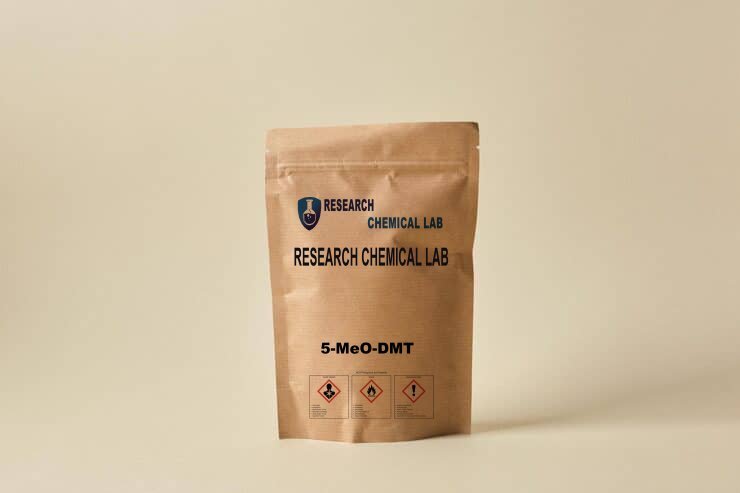

5-MeO-DMT hydrochloride
5-MeO-DMT hydrochloride properties
Synonym: 5-methoxy-N,N-dimethyltryptamine hydrochloride
CAS Number: n/a
Formula: 3-[2-(dimethylamino)ethyl]-5-methoxyindole hydrochloride
Molar mass: 254.8 g/mol
Purity: >97%
€25.00 – €360.00Prijsbereik: €25.00 tot en met €360.00
* The information on this page is a summary and is not intended to cover all available information about this medication. It does not cover all possible uses, directions, precautions, drug interactions or adverse effects and is not a substitute for the expertise and judgement of your healthcare professional.
5-MeO-DMT Hydrochloride – Scientific Product Documentation
General Description
5-MeO-DMT hydrochloride (5-Methoxy-N,N-dimethyltryptamine HCl) is a water-soluble salt of classical tryptamine, particularly suitable for pharmacological research due to its increased stability and bioavailability compared to the freebase form.
Technical Specifications
| Parameter | Specification |
|---|---|
| Chemical Formula | C₁₃H₁₈N₂O · HCl |
| Molecular Weight | 254.75 g/mol |
| Purity | ≥98% (analyzed by HPLC-UV) |
| Appearance | White to light yellow crystalline powder |
| Solubility | High in water (>50 mg/ml), methanol, PBS |
| Melting point | 243-247°C (decomposes) |
| Stability | Hygroscopic; store in dry conditions |
Scientific Applications
1. Neuropharmacology & Behavioral Research
Serotonin receptor studies: Potent 5-HT₁ₐ/₂ₐ agonist with rapid cerebral penetration.
Animal experiments (in vivo): Behavioural paradigms (e.g. head-twitch response in rodents).
Electrophysiology: Effects on neuronal oscillations (e.g., gamma-band activity).
2. Biochemical & Molecular Studies
Intracellular signaling: cAMP accumulation and β-arrestin recruitment assays.
Enzyme kinetics: MAO-A metabolism (IC₅₀ ~2-5 μM).
3. Clinically Relevant Research
Dose-response relationships: Preclinical safety profiling.
Comparative pharmacology: Towards psilocybin, DMT, and other tryptamines.
Experimental Guidelines
Recommended Concentrations
| Application | Concentration range | Solvent |
|---|---|---|
| Cell cultures (in vitro) | 1 nM – 10 μM | PBS/DMEM (≤0.1% DMSO) |
| Receptor assays | 0.1 – 100 μM | Tris-HCl buffer (pH 7.4) |
| Animal studies (ip/iv) | 0.1 – 5 mg/kg | Sterile saline solution |
Safety measures
Personal protection: Lab coat, gloves (nitrile), safety glasses.
Handling: Hygroscopic – close promptly after use.
Storage: Airtight, under argon, at -20°C (prevent hydrolysis).
Stability & Storage
Shelf life:
-20°C: >2 years (unchanged purity).
4°C: 6 months (in dry environment).
Relegation:
Hydrolysis on prolonged exposure to moisture (monitor by HPLC).
Analytical Validation
Each batch comes with:
HPLC-UV chromatogram (C18 column, retention time ~6.2 min).
MS/MS fragmentation (characteristic ions: m/z 219 → 174, 160).
Residual solvents (meet ICH Q3C guidelines).
Legal Status (Netherlands/EU)
Narcotics legislation: Not explicitly mentioned in the Opium Act, but possibly under analogous legislation (Appendix II).
Scientific use: Permit required for institutions (CCMO approval for animal testing).
Export control: Subject to EU Regulation 2019/1998 (psychotropic substances).
Frequently Asked Questions (FAQ)
Q1 : What are the advantages of HCl over freebase?
Improved solubility (ideal for injection studies).
Longer shelf stability at room temperature.
Q2: Is 5-MeO-DMT-HCl detectable in drug tests?
A: Yes, via:
LC-MS/MS (recognized as 5-MeO-DMT + HCl adduct).
Immunoassays: Cross-reactivity with DMT (~15-20%).
Q3: Are there risks when combining with MAO inhibitors?
A: Absolutely.
Increased risk of serotonin syndrome (avoid combination!).
Use only in MAO-free models.
Q4: How to dispose of waste?
A:
Neutralize with sodium bicarbonate (pH 7-8).
Adsorb with activated carbon .
Dispose of as hazardous chemical waste (UN 3249, Class 6.1).
References & Contact
Core literature:
Shen et al. (2010). “Pharmacology of 5-MeO-DMT derivatives”. J Psychopharmacol .
Kaasik et al. (2021). “Metabolic pathways of 5-MeO-DMT”. Xenobiotics .
This product is intended only for authorized scientific research. Not for human consumption or diagnostic use. Please observe local regulations.
Frequently asked questions
A seemingly elegant design can quickly begin to bloat with unexpected content or break under the weight of actual activity. Fake data can ensure a nice looking layout but it doesn’t reflect what a living, breathing application must endure. Real data does.
Websites in professional use templating systems. Commercial publishing platforms and content management systems ensure that you can show different text, different data using the same template. When it’s about controlling hundreds of articles, product pages for web shops.
A seemingly elegant design can quickly begin to bloat with unexpected content or break under the weight of actual activity. Fake data can ensure a nice looking layout but it doesn’t reflect what a living, breathing application must endure. Real data does.
Websites in professional use templating systems. Commercial publishing platforms and content management systems ensure that you can show different text, different data using the same template. When it’s about controlling hundreds of articles, product pages for web shops.




 NL_BE
NL_BE  NL
NL  DE
DE  PT
PT  FR
FR  ES
ES  IT
IT  CS
CS  SK
SK  PL
PL  RU
RU  ZH
ZH  EN
EN  IS
IS  NB
NB  NN
NN  SV
SV  DA
DA  DE_AT
DE_AT  SL
SL  TR
TR  FI
FI  AR
AR  ET
ET  FR_BE
FR_BE  HR
HR