

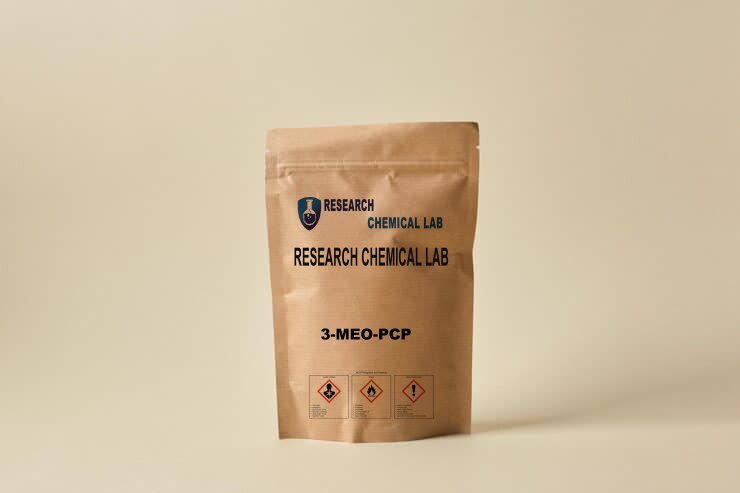
3-MEO-PCP
3-MeO-PCP properties
Synonym : 1-[1-(3-methoxyphenyl)cyclohexyl]-piperidine, monohydrochloride
CAS Number : 91164-58-8
Formula : C18H27NO • HCL
Molar mass : 309.9 g/mol
Purity : ≥98%
€111.15
* The information on this page is a summary and is not intended to cover all available information about this medication. It does not cover all possible uses, directions, precautions, drug interactions or adverse effects and is not a substitute for the expertise and judgement of your healthcare professional.
3-MeO-PCP (3-Methoxyphencyclidine) – Dissociative Research Substance of the Arylcyclohexylamine Class
What is 3-MeO-PCP?
3-MeO-PCP (3-Methoxyphencyclidine) is a synthetic dissociative compound related to PCP and ketamine. It belongs to the arylcyclohexylamine class and is used exclusively for scientific research on NMDA receptor interaction and dissociative pharmacology. 1cP-LSD 150 MCG Art Blotters
Key Features
- Purity ≥98% (confirmed by GC-MS, HPLC and NMR)
- White crystalline powder, uniform in consistency
- Advanced packaging with oxygen and moisture absorbing materials
- Complete batch-specific documentation and reference spectra. O-DSMT 50mg Pellets
Pharmacological Profile
- NMDA receptor antagonism : potent blockade of glutamate activity
- Secondary effects on monoamines : dopamine and serotonin modulation
- Kinetics (preclinical) :
- Rise: 30–60 minutes
- Duration of action: 4–6 hours
- Half-life: 7–9 hours
Research purposes
- Neurochemical research
- NMDA receptor mechanism
- Anesthesia and neuroprotection models
- SAR studies
- Methoxy substitution versus other PCP derivatives
- Structural effects on receptor affinity
- Behavioral models
- Dissociative and sensory effects
- Pain processing and perception
- Cognitive dysfunction in animal models
Technical Specifications
- Molecular formula: C17H25NO
- Molecular weight: 259.39 g/mol
- Melting point: 235–238°C
- Solubility: >50 mg/ml in ethanol
Analytical Data
- HPLC retention time: 9.2 ± 0.3 min (C18 column)
- Mass spectrometry: m/z 260 [M+H]+
- ¹H NMR (CDCl₃): δ 7.3–7.5 (m, 4H), 3.8 (s, 3H), 2.4 (m, 2H)
Dosage information (for reference only)
- In vitro: 0.1–10 µM
- Preclinical: 0.1–1.0 mg/kg body weight
- Chemical analysis: 5–15 mg per test
Safety and Storage
- Shelf life: 36 months at -20°C
- Storage: airtight container under inert gas
- Compatible with standard buffers and solvents
- Always process under a fume hood and laboratory environment
Research documentation
Each order contains:
- Certificate of Analysis (COA)
- Safety Data Sheet (SDS)
- Technical datasheet
- Full spectral set: ¹H NMR, ¹³C NMR, FTIR, MS
For scientific use only. Not suitable for human consumption or diagnostic applications. 1V-LSD 150 MCG Blotters
Frequently asked questions
A seemingly elegant design can quickly begin to bloat with unexpected content or break under the weight of actual activity. Fake data can ensure a nice looking layout but it doesn’t reflect what a living, breathing application must endure. Real data does.
Websites in professional use templating systems. Commercial publishing platforms and content management systems ensure that you can show different text, different data using the same template. When it’s about controlling hundreds of articles, product pages for web shops.
A seemingly elegant design can quickly begin to bloat with unexpected content or break under the weight of actual activity. Fake data can ensure a nice looking layout but it doesn’t reflect what a living, breathing application must endure. Real data does.
Websites in professional use templating systems. Commercial publishing platforms and content management systems ensure that you can show different text, different data using the same template. When it’s about controlling hundreds of articles, product pages for web shops.




 NL
NL  DE
DE  PT
PT  FR
FR  ES
ES  IT
IT  CS
CS  SK
SK  PL
PL  RU
RU  ZH
ZH  EN
EN  NL_BE
NL_BE  IS
IS  NB
NB  NN
NN  SV
SV  DA
DA  DE_AT
DE_AT  SL
SL  TR
TR  FI
FI  AR
AR  ET
ET  FR_BE
FR_BE  HR
HR